Trading with customers
Not every sale in TCG Card Shop Simulator is a shelf purchase: the game defines a card trading screen and tracks what a customer is doing with its own set of states.
No confirmed picture from the game yet. This subject is kept as a note for now: the facts below are verified against the game's own files, but no image has been confirmed for it, so it is not published as a finished entry and is kept out of search engines.
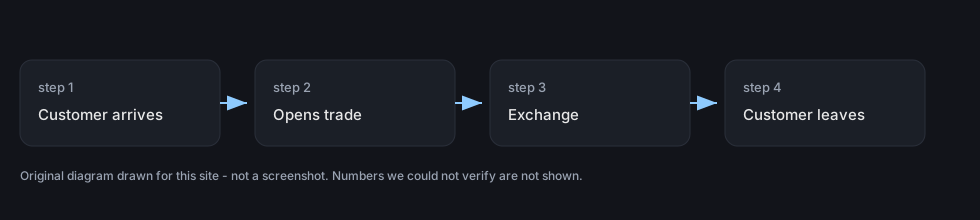
What the game establishes
- Trading with a customer has its own screen in the game.
- The build names a group of its own for changing money at the counter.
- Customer behaviour is tracked as a set of states.
- Cards handled in trade are the same card objects as elsewhere in the shop.
- A customer's trade record holds whether they are trading and the last price quoted to them.
- It holds the two cards on the table, one on the left and one on the right.
In play
Trading is its own interface in the game, so a trade is a different kind of sale from a customer picking something off a shelf.
Customers have tracked states, which is why the shop can react to a customer who is browsing, waiting or leaving rather than treating them as a single behaviour.
A trade is kept as a record of its own. It holds whether the customer is trading and the last price quoted to them, which is how a negotiation can be picked up again rather than restarted.
The table has two sides. The record keeps the card on the left and the card on the right, so a trade is stored as two positions rather than as a loose pair of cards.
Because trading happens at a screen, keeping a counter free matters when a customer wants to trade rather than buy.
What this entry does not tell you: how often customers offer trades, what they will accept, or how much profit a trade makes. We have not verified those numbers, so we do not print them.