What the game records about a deck
A deck in TCG Card Shop Simulator is stored as more than a pile of cards: it has a name, a list of the monster kinds in it, its card data, and separate lists for a main win condition, an early and a late one, searchers, monsters that wait, freeze-counter cards, last plays and disruption.
No confirmed picture from the game yet. This subject is kept as a note for now: the facts below are verified against the game's own files, but no image has been confirmed for it, so it is not published as a finished entry and is kept out of search engines.
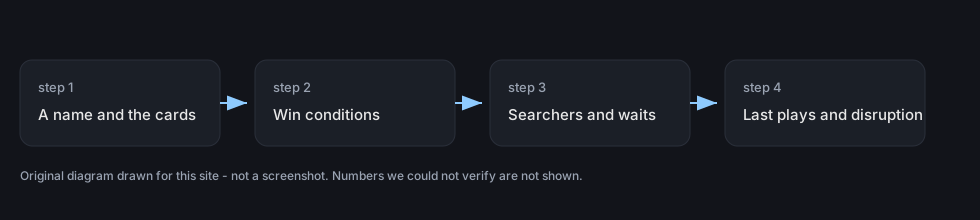
What the game establishes
- A recorded deck has a name, a list of monster kinds and its card data.
- It records a main win condition as a list of monster kinds.
- It records an early win condition and a late one separately.
- It records searchers.
- It records monsters that wait for a guardian card and monsters that wait for a freeze counter.
- It records freeze-counter cards of its own.
- It records last-play cards.
- It records disruption.
In play
A deck is recorded as a description of itself. It has a name of its own, so a list of decks can be told apart without reading the cards in each one.
It keeps the monsters it holds. There is a list of the monster kinds in the deck, alongside the card data itself, which is why what a deck is made of and what it does can be read as two different things.
It names a main win condition. That is a list of its own rather than a flag, so a deck can be built around more than one creature that finishes a game.
It also names an early and a late win condition. Splitting them means a deck can be described as a thing that pressures quickly or one that closes a long game, rather than only as having a plan.
It records searchers. Those are the monsters whose job is to find other cards, which is why searching is a role in the data rather than only something a card does in play.
It records monsters that wait. There are separate lists for those that wait for a guardian card and for those that wait for a freeze counter, so the deck knows what it is waiting behind as well as what it is waiting for.
It records freeze-counter cards of its own, which is the other half of that pairing: what is waited for and what does the waiting are kept apart.
It records last plays. Those are the cards a deck intends to finish with, so the end of a game is part of the deck's description rather than an accident of what was drawn.
It records disruption as well. That is the list of cards meant to interfere with the other side, which is why a deck can be described by what it takes away as much as by what it plays.
What this entry does not tell you: how many cards any deck holds, what any win condition requires, or how a deck is chosen for you. We have not verified those numbers, so we do not print them.