Shop, shelves and fixtures · TCG Card Shop Simulator · read from a local copy
The money the counter handles
A piece of money at the counter can be a coin or a note, and it carries that on the object.
The cash at a counter in TCG Card Shop Simulator is made of objects rather than numbers: each piece of money knows whether it is a coin or a note, carries a value in two kinds of number and an index, has its own model and outline, and belongs to a list of currency data kept by the counter.
What the game establishes
- A piece of money at the counter can be a coin or a note, and it carries that on the object. (checked against the game's own files)
- Each piece of money carries a value as an ordinary number and as a more precise one, plus an index. (checked against the game's own files)
- The counter keeps a list of currency data that the money refers to. (checked against the game's own files)
- A piece of money has a model and an instance of that model. (checked against the game's own files)
- It has renderers for the plain object and for the instanced one. (checked against the game's own files)
- Coins have a mesh group and their own plain and instanced renderers. (checked against the game's own files)
- A note and a coin each have an outline of their own. (checked against the game's own files)
- A piece of money is tied to the cashier counter it belongs to. (checked against the game's own files)
- Money is also a world object with a mesh, a highlight, colliders, pickup and move rules and placement limits for the shop and the warehouse. (checked against the game's own files)
- Money can be scanned at the counter. (checked against the game's own files)
- The game ships a texture sheet for each of its currencies with both coins and notes on it. (checked against the game's own files)
- A coin spawning has a sound of its own in the build. (checked against the game's own files)
In play
Money at the counter is not a balance that goes up and down. Change is made of objects you handle, and each one is an interaction in the world rather than a line in an account.
It knows what it is. A piece of money can be either a coin or a note, and the game keeps that distinction on the object itself, which is why the same handling can produce different things to pick up.
It carries its value. There is a value kept as an ordinary number and the same value kept at a higher precision, along with an index of its own, so a piece of money can be identified as well as counted.
It belongs to a currency. The counter keeps a list of currency data, and a piece of money refers to that rather than assuming one currency, which is why the counter can be set up for a different kind of money.
It has a model and an instance of that model. Both are recorded, which is how one shape can be drawn many times on a counter without each piece being a new object in the game's memory.
It is drawn twice over. There are renderers for the plain object and for the repeated one, and coins have a mesh group and their own pair of renderers, so a handful of coins is cheaper to draw than a handful of separate things.
It shows its own outline. A note and a coin each have an outline of their own, which is how what you are about to pick up is picked out from the counter beneath it.
It knows where it belongs. A piece of money refers to the cashier counter it sits on, which is why what you pay with and what you are given back are tied to the same fixture.
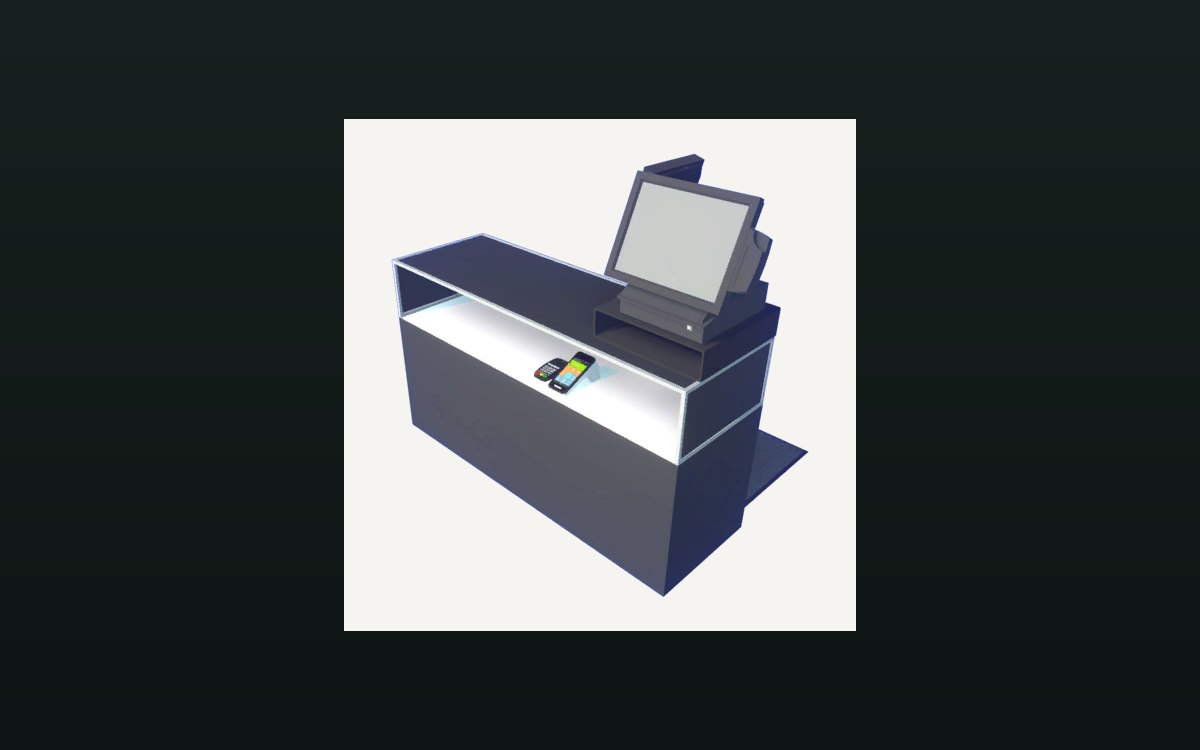
It is still an object in the world. Money has a mesh, a highlight, colliders, pickup and move rules, and rules about whether it may be placed in the shop or only in the warehouse, and it can be scanned at the counter.
The images beside this entry are the game's own: the sheets it ships for two of its currencies, each carrying both coins and notes.
What this entry does not tell you: which currencies the game supports, what any coin or note is worth, or how a purchase is worked out. We have not verified those numbers, so we do not print them.
Related
 Shop, shelves and fixturesThe counter and money handlingA cash change at the counter is its own interaction.
 Pricing and the marketThe currencies the game tracksThe game keeps a fixed list of currencies.
Version and sources
A local copy of the game, read only. The grounding for each fact is listed on the technical reference pages; nothing here is estimated. Documented build: no version stated by this build.